- Authors

- Name
- Desi Ilieva
Previous Article
The Core Idea
Like every concept existing in sciences, it's core is based on a very simple idea. In this article we will discuss further in terms of physics and mathematics the basic idea of superposition, which is:
- Superposition occurs when multiple influences act on something at the same time, the result is the combination of all of them.
Why is Called Superposition
Actually the word superposition have a explicit and true meaning when we break the word apart:
super - (from Latin) on top of, over, above, etc.
position - placement, state, value, etc.
Then the literal meaning of the word superposition is:
- Placing one state on top of another
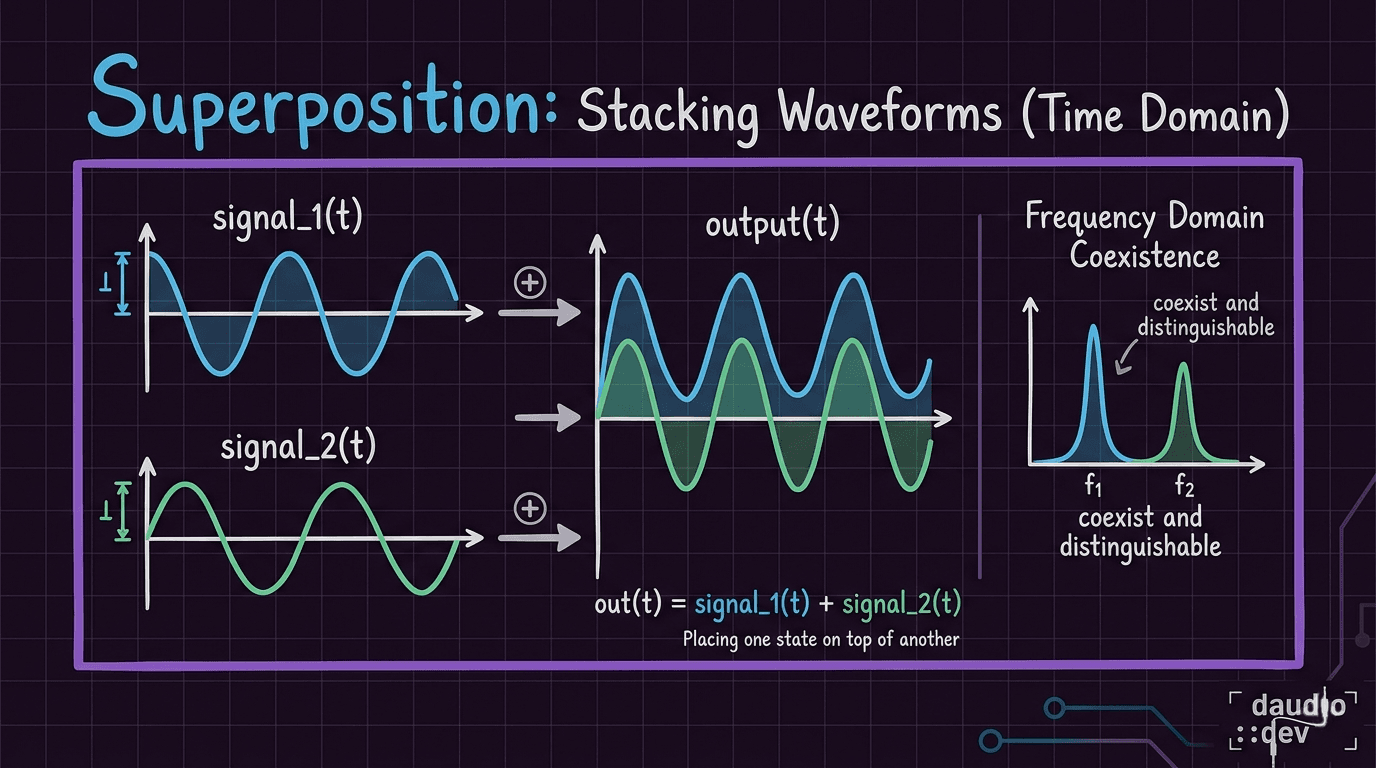
In DSP terms, we're stacking waveforms, signals, or frequency components together to create a combined output. Superposition can be used only in linear systems and proposes us a variety of signal processing techniques.
Superposition in Waves and Audio
When working with audio signals, superposition is everywhere:
In the time domain: If you have two audio signals, signal_1(t) and signal_2(t), their superposition is just their sum:
output(t) = signal_1(t) + signal_2(t)

For example when you mix multiple tracks in your DAW, each track's waveform adds together. A kick drum at 0.5 amplitude plus a bass at 0.3 amplitude gives you 0.8 at that moment in time.
In the frequency domain: In the frequency domain different frequencies can coexist in the same signal without interfering with each other's identity. A 440 Hz sine wave (A note) plus a 880 Hz sine wave (A an octave higher) creates a richer tone, but both frequencies are still present and distinguishable.
Why in Linear Systems Only?
Superposition only works in linear systems. But why?
First what does "linear" mean? A system is linear if it follows two rules:
- Scaling (Homogeneity): If you double the input, you double the output
- Additivity: The output for (input A + input B) equals (output A + output B)
Check out our article about linear systems for more detailed info: When a system is linear and when is not?
So why in linear systems only? Because superpostion is simply based on the same rules that are required for a system to be linear. We stack different sounds with different amplitudes we sum the sound's amplitudes to get the total mix amplitude. The same happens when we stack two frequencies with same phase, like a chord we play on the guitar. We can hear the different notes separately and we define the chord, then the total amplitude is increased by the sum of all notes's amplitudes.
For example when you use saturation, the output isn't a simple sum anymore. Harmonics get generated, waveforms get shaped, compressed, amplified and this is what introduces the non-linearity.
Why This Matters for DSP
So what are the techniques that superposition unlocks:
Fourier Analysis: Any complex waveform can be broken down into a superposition of simple sine waves. This is how EQs, analyzers, and spectral processors work. (ex. DIRLoader IR spectrograms)
Impulse Responses: A linear system's behavior can be completely described by how it responds to a single impulse. Convolution reverbs use superposition to apply this response to any input signal (DIRLoader's IR + input signal mix !).
Parallel Processing: You can split a signal, process each copy differently, then add them back together. This works because of superposition in the mixing stage.
Filter Design: Complex filters are often built by combining (superimposing) simpler filter responses.
Plugin Example of Superposition
Imagine you're designing a plugin that adds three harmonics to a sine wave:
input = sin(2π × 440 × t)           // 440 Hz fundamental
harmonic_2 = 0.5 × sin(2π × 880 × t)  // 2nd harmonic
harmonic_3 = 0.3 × sin(2π × 1320 × t) // 3rd harmonic

output = input + harmonic_2 + harmonic_3
That's superposition and you're literally stacking waveforms. The output contains all three frequencies simultaneously, and each contributes independently to the final sound. It's like you playing a 3 note chord - it has it own charm but you can still distinguish the different notes in it.
Summary
Superposition is a quality in linear systems, where the combined output of multiple inputs equals the sum of their individual outputs. This principle is a basis of mixing (waveform addition), Fourier analysis (signal decomposition into sine waves), and convolution (impulse response processing).
Superposition only applies to linear systems beacuse it's based on their scaling and additivity rules. Non-linear processes like saturation, compression, waveshaping violate superposition by generating new harmonics and signal interactions.
Knowing when superposition applies versus when it breaks is essential for DSP design and signal analysis.